
HRSA READINESS
Know your HRSA readiness before the site visit is scheduled.
Most health centers can answer “are we compliant?” eventually. The question is how long eventually takes, and whether the answer changes once someone actually goes looking for the evidence.
Readiness is usually a scramble, not a status.
The evidence exists — somewhere
Credentialing files, board minutes, the sliding fee schedule, the QI plan, the last risk assessment. Almost none of it is missing. It is in a share drive, an inbox and three binders, and only the person who filed it knows which.
Nobody knows the real state until someone asks
Status lives in the heads of the people who own each area. That works until two of them are on leave the week the notification arrives, or until the board asks for a number nobody has.
Assembling the answer takes longer than knowing it
The work before a site visit is rarely fixing something. It is proving something that has been true for two years — and that proving is what consumes the weeks.
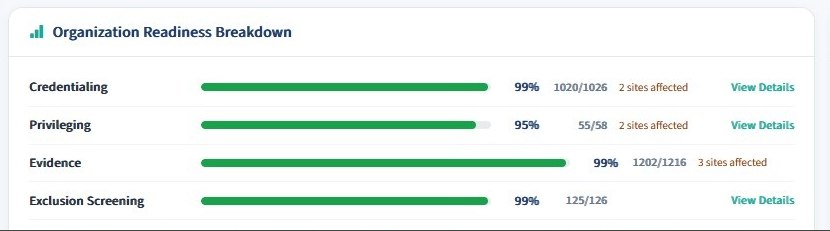
A readiness figure for the organization, and one for every site.
An organization-level number hides the site that is dragging it down, and a per-site number without the whole gives no one a decision. RIEL keeps both, computed from the requirements you configure rather than from a fixed checklist someone else wrote.
- Organization and per-site scoring
- Top blockers ranked by impact, not by date entered
- Evidence completeness by site visit chapter
- One-click organization review package
Evidence filed where a reviewer will look for it.
The reason a well-run health center still spends weeks preparing is structural: your evidence is organized the way your operation is organized, and the review is organized the way the program requirements are. Every piece has to be found again and re-sorted into someone else's order.
RIEL keeps the second organization alongside the first. Evidence is attached to the requirement it satisfies as it is produced, so completeness by chapter is a view rather than a project. The organization review package is the same material exported in one pass.
The mapping is yours to configure and yours to maintain — which is the honest arrangement, because it is the only one that survives HRSA updating its own documents.
The documents this is organized against. HRSA states the Health Center Program requirements in the Health Center Program Compliance Manual, and conducts Operational Site Visits against a published Site Visit Protocol, which is the document a reviewer actually works from. Both are maintained by HRSA's Bureau of Primary Health Care and both are revised periodically.
RIEL is not a source of requirements. It does not ship an interpretation of what HRSA expects, and it does not tell you that a requirement applies to you. The requirements, the evidence each one needs and the sites each one covers are configured by your organization against the current HRSA documents. That is a deliberate choice: a vendor's baked-in checklist is wrong the day HRSA revises the manual, and wrong silently.
Nothing on this page is legal or regulatory advice, and nothing here substitutes for the current HRSA documents.
What RIEL changes
- Readiness is a number you can look at on a Tuesday, not a project that starts when the notification arrives.
- Evidence is attached to the requirement it satisfies, so completeness by chapter is a view rather than a week of collecting.
- Gaps are ranked by what they cost you, so the first thing on the list is the first thing worth doing.
- Each gap has an owner and a date, and its history is recorded — including who closed it and with what.
- Credentialing, privileging, policies, governance, sliding fee, QI and enrollment feed the same picture, so an expiring license or an overdue policy review surfaces as a readiness gap and not only in its own module.
- The board gets the same figure the compliance officer sees, from the same source, without anyone assembling a deck.
What it does not
- The score is RIEL's, not HRSA's. HRSA does not issue a readiness percentage. The number measures your evidence against the requirements you configured — it is a management figure, and it is not a prediction of a finding.
- It does not submit anything to HRSA. Nothing leaves RIEL for EHB; the package is yours to review and file.
- It does not decide which requirements apply to your center, and it does not interpret them for you.
- It does not write your policies, your QI plan or your risk assessment. It tracks whether they exist, are current and are approved.
- It does not replace the site visit, and a high score is not a clean visit. What it removes is the surprise.
Corrective action that starts with a list, not an investigation.
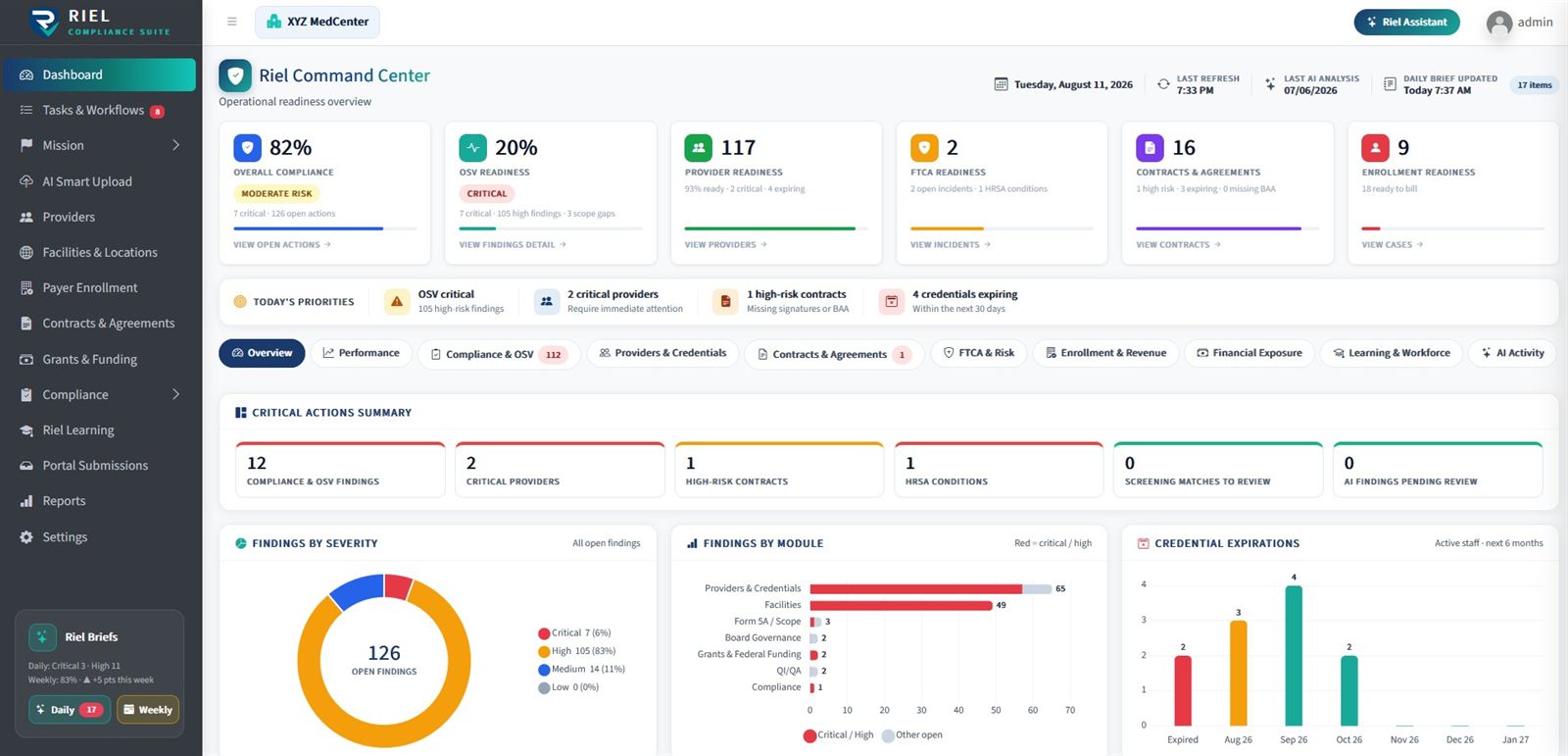
A finding is only useful if it arrives with the two things that let someone act on it: what specifically is missing, and who is going to close it. RIEL raises gaps as findings with an owner and a due date, and keeps them visible until the evidence that closes them is attached.
- Named gaps — the missing item, not a red category
- An owner and a date on every open finding
- Closed by evidence, not by marking it done
- Readiness KPIs on the Command Center, next to everything else
Readiness is fed by the modules, not typed into a tracker.
A readiness figure that someone updates by hand is a second system that drifts from the first. In RIEL the figure is a consequence: a credential that expires, a privilege that lapses, a policy past its review date, a board approval that never happened, a provider not yet participating with a plan — each of those already lives in its own module, and each one moves the readiness picture on its own.
That is also why the number is worth looking at between site visits. It is measuring the operation, not the preparation for a review.
Provider credentialing and payer enrollment work the same way, and the module tour walks through the rest.
What would your readiness figure say today?
Thirty minutes, your requirements, your sites. If the answer is that you already know where everything is, that is a useful thing to have confirmed.