
PROVIDER CREDENTIALING
The provider file, complete and verifiable.
Credentialing is not hard because the rules are obscure. It is hard because the file lives in eleven places, the verification that proves it happened lives in a twelfth, and the person who can reconstruct the story is on vacation.
Sixteen sections, one workspace.
Demographics, credentials, privileging, education, work history, malpractice coverage, locations. Not sixteen screens you navigate between — sixteen sections of one record, each with its own completeness, saved together.
- NPPES verification, individual and batch
- PR license verification via ORCPS agent
- Clinical privileging with blockers and 90-day renewals
- OIG LEIE, SAM.gov and applicable state exclusion screening

Primary source verification that runs live — and an honest account of which sources.
Two sources are queried directly from RIEL, in real time, with the response stored as the evidence: NPPES, individually or in batch, and Puerto Rico's ORCPS for professional licenses, through our own verification agent. That last one exists because there is no national aggregator that covers it.
Everything else in the file — board certification, malpractice history, education, work history, references, DEA where it applies — is verified the way your team verifies it today, and recorded here with its source, its date and its document. RIEL does not claim to query sources it does not query. A system that quietly presents a manually confirmed item as an automated verification is worse than one that does neither, because it removes the one signal that told you to look closer.
The distinction is visible on the record. You can always tell which checks the system ran and which a person did.
Four verification states, and the fourth is the one that matters.
Verified
The source answered and the answer matches the file. The response itself is stored, not a checkbox recording that someone looked.
Discrepancy
The source answered and the answer does not match. The record stays open with both values visible, so the person resolving it sees what actually differs.
Expired
The credential itself has lapsed. Distinct from a failed check: nothing is wrong with the verification, the thing being verified is out of date.
Unable
The source did not answer, or could not be reached. This is not a pass. It stays visible as unresolved rather than collapsing into a green check.
Most of the value is in keeping the fourth state separate from the first. A registry that times out, a portal down for maintenance, a name that returns nothing — those are not verifications, and a file that treats them as such looks complete right up until someone asks for the evidence behind it.
What RIEL changes
- One record per provider, sixteen sections, saved together — not a folder, a spreadsheet and a shared inbox.
- NPPES and ORCPS checks run from inside the file, and the response is stored as the evidence.
- Verification states stay distinct, so “we could not reach the source” never reads as “verified”.
- Expirations and recredentialing dates surface ahead of time instead of on the day.
- The same record feeds privileging, exclusion screening, payer enrollment and HRSA readiness — one gap, not four places to update.
- What was checked, when, by whom and with what result is recorded, which is the part a reviewer actually asks for.
What it does not
- RIEL is not a CVO. It does not perform verification as an outsourced service. It runs the checks it can run and holds the evidence; your team and your credentialing committee still do the work that is theirs.
- It does not query every primary source. NPPES and ORCPS are live; the rest are recorded, and the page above says so rather than leaving it to be discovered.
- It does not decide who is qualified. Verified is a statement about a source, not a judgment about a person.
- It does not grant privileges or approve a provider. Those are decisions with an owner, and RIEL records them rather than making them.
- It does not replace your credentialing policy. It enforces the one you already have.
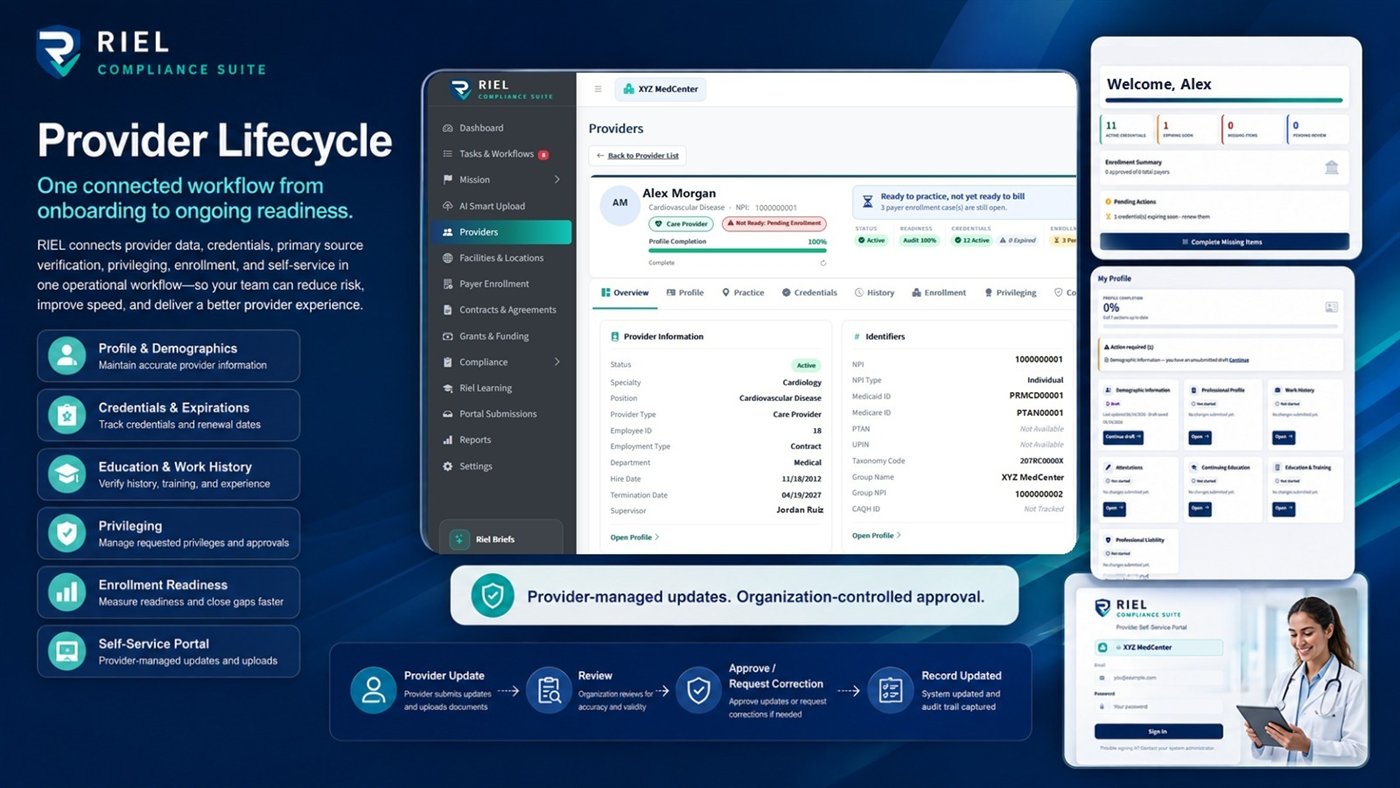
Recredentialing and expirations, before they lapse.
A lapsed license is rarely a surprise to the calendar — only to the people. Every dated item in the file carries its own horizon, and the ones approaching become work with an owner rather than a red cell someone will notice eventually.
- Expirations surfaced ahead of the date, not on it
- Privileging renewals at 90 days, with blockers named
- Providers update their own file; you review and approve
- A lapse becomes a readiness gap, not only a credentialing one
Provider-managed updates, organization-controlled approval.
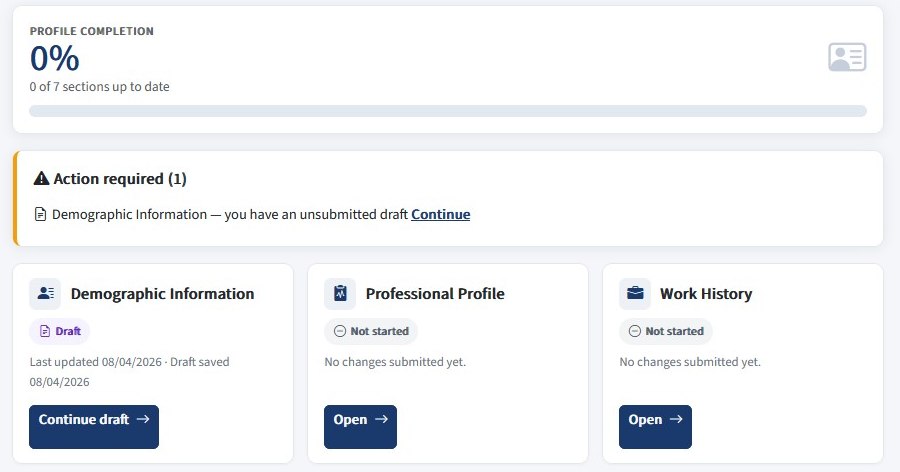
The person who knows a license was renewed is the provider holding it. Most of the chasing that credentialing staff do exists only because there is no way for that person to hand the document over without going through someone.
The portal closes that loop without giving up control: providers maintain their own profile and submit documents, and nothing they submit becomes part of the record until your team reviews and approves it. Self-service here means less transcription, not less oversight.
- Profile updates
- Document submissions
- Attestations
- Review & approval
What makes credentialing in Puerto Rico different.
Credentialing software is a crowded category, and most of it is built around an assumption that does not hold here: that the provider already has a maintained national profile the plans will accept. There is no CAQH in Puerto Rico. The file is assembled and maintained by you, and it is the only copy.
Licenses verify against ORCPS, which no national aggregator covers — which is why RIEL runs its own verification agent against it rather than listing it as a manual step and moving on. And enrollment cannot begin until the provider and the facility are registered and current in the Medicaid Provider Enrollment Portal, so a credentialing file that is complete but stale has a downstream cost that is easy to miss.
That is the whole argument for a platform built here rather than adapted: the parts that are hardest locally are the parts a mainland product treats as an afterthought.
The same record continues into payer enrollment, carries the exclusion screening evidence, and rolls up into HRSA readiness; the module tour covers the rest.
Ask to see one provider file, end to end.
Not a feature list — an actual record, from intake through verification, expirations and approval, with the evidence attached at each step. Thirty minutes is enough to tell whether it fits how you work.