
PAYER ENROLLMENT
Ready to practice is not ready to bill.
A provider can be licensed, credentialed, privileged and seeing patients while still not participating with a single plan. Payer enrollment is the step that closes that gap, and it is the one most often tracked in a spreadsheet that only one person understands.
The distance between hired and billable, and who owns each day of it.
Internal days
Assembling the packet, chasing a signature, discovering a missing attestation three weeks in. Nobody outside your organization is holding these days up — which is why they are the ones worth measuring.
Payer days
The plan's own processing time once a complete application is on file. RIEL does not shorten these, and neither does any other system. What it does is stop them from starting later than they had to.
Silent days
The case that was submitted, acknowledged, and then went quiet for six weeks because the follow-up lived in someone's memory rather than on a date. These read like payer days on a spreadsheet. They are not.
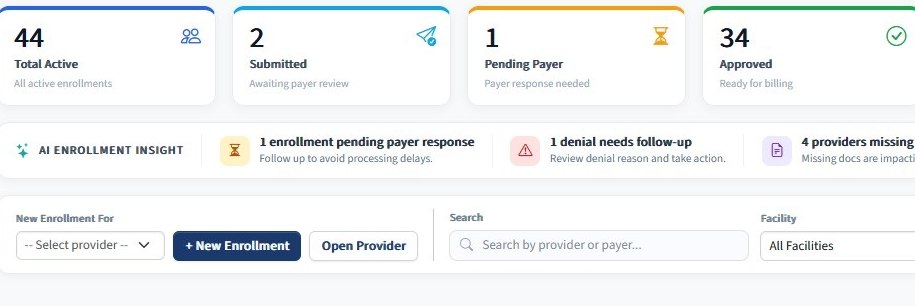
Every case, every plan, every provider on one board.
Enrollment is not one process repeated; it is a different process per plan, per provider, running at different speeds at the same time. The board holds each case where it actually is, so a status question does not require opening five folders.
- Enrollment pipeline — every open case and its current stage
- Packet readiness — what is still missing, named, before you submit
- Effective dates — recorded per case, not reconstructed later
- Billing readiness — which providers can be billed for today, and for which plans
The effective date is what decides whether the gap costs you anything.
A provider seeing patients before participation is active does not automatically mean lost revenue. It depends entirely on the effective date the plan assigns and on how far back you are allowed to bill from it. Some of that window is written into federal regulation; most of it is written into your contracts.
This is the part of enrollment that is worth recording at the moment it happens rather than reconstructing months later from an email thread. RIEL keeps the effective date and the retroactive window on the case itself, so the question “can we still bill for March?” has an answer that does not depend on who is in the office.
42 C.F.R. § 424.521 — physicians, non-physician practitioners and their organizations may bill Medicare retrospectively for services furnished up to 30 days before the enrollment effective date where circumstances precluded enrolling in advance, and up to 90 days where a Presidentially-declared disaster under the Stafford Act intervened.
42 C.F.R. § 424.520(d) — the effective date is the later of the filing date of the application that was subsequently approved and the date the provider first began furnishing services. This is why the internal days before submission carry a direct financial consequence: they move the effective date forward with them.
Commercial plans generally set the effective date at contract execution or credentialing-committee approval, with no retroactive window at all. Verify against the contract in force.
These citations describe Medicare enrollment. They do not describe Puerto Rico Medicaid or commercial plan rules, and nothing on this page is legal, accounting or billing advice.
Put a number on it before you decide anything
The ROI calculator works from your own provider count, payer mix and enrollment timeline. It separates what can still be billed retroactively from what is permanently gone, and shows every assumption so you can disagree with it.
What RIEL changes
- Every open case is visible in one place, with its stage, its owner and its next date.
- Packet gaps are named before submission instead of discovered by a rejection letter.
- Effective dates and retroactive windows are recorded on the case as they are confirmed.
- Each case carries the plan's own tracking or confirmation number, so a follow-up call starts with a reference instead of a name and an approximate date.
- Credentialing, privileging and enrollment share one provider record, so an expiring license surfaces on the enrollment case too.
- Everything is logged, so the answer to “when was this submitted” is a record rather than a recollection.
What it does not
- It does not submit applications to plans on your behalf. You review and file in the plan's own portal; RIEL prepares and checks what goes in.
- It does not shorten a payer's processing time. No system does.
- It does not guarantee approval, and it does not replace the judgment of your credentialing committee.
- It is not a billing system or a clearinghouse. It tells you when a provider is billable; your practice management system does the billing.
- It does not decide your retroactive windows for you. Those come from regulation and from your contracts, and you enter them.
Built for how enrollment actually works in Puerto Rico.
There is no CAQH here. A packet is not pulled from a national profile that the plan already trusts — it is assembled and tracked per plan, which is precisely why packet readiness stops being a clerical detail and starts being the thing that determines the submission date.
Every provider and facility must be registered and current in the Medicaid Provider Enrollment Portal before enrollment can begin. RIEL treats that registration as an explicit prerequisite on the case rather than an assumption, because a packet submitted while it is lapsed does not fail quietly — it fails after the wait.
Licenses verify against ORCPS rather than a national aggregator, and exclusion screening runs against the OIG LEIE and SAM.gov with the evidence stored against the provider. The same record that clears a provider to be enrolled is the one an auditor asks to see.
RIEL was built inside these constraints rather than adapted to them afterward. More on what that means across the platform.
The same provider record that clears enrollment also feeds HRSA readiness: a lapsed license or an expired privilege shows up as a readiness gap, not only as an enrollment blocker. That record starts in credentialing, which is where the packet's contents come from in the first place.
How many days sit between hired and billable at your center?
Start with the number. If the gap turns out to be small, you have saved yourself a software evaluation; if it is not, you will know what it is worth fixing.